


How LASENOR® VP-100 Helps the Bakery Industry Face Rising Egg Costs
Egg prices have climbed sharply in many markets since 2022, adding volatility to cake production costs and planning. Eggs remain essential for structure, aeration, and tenderness; however, they are costly, and exposed to supply shocks. A pragmatic path forward is reducing egg usage while preserving indulgence. LASENOR® VP-100, a texturized pea protein co-developed with Meala, helps bakeries keep softness, volume, and shelf life while lowering recipe exposure to egg-price swings and supporting cleaner labels.
Egg is considered an ideal functional food ingredient, containing a mix of proteins, fatty acids, phospholipids, minerals, vitamins, and antioxidants. Its composition makes it a versatile material used for various purposes such as gelation, emulsification, foaming, binding, coloring, and flavoring. This versatility enhances many food products, offering a wide range of textures from salad dressings to foams, cakes, omelets, and more.
The main contributors to the diverse functions of eggs are the protein content in both the egg white and yolk. Egg white contains globular proteins that help create aerated systems like foams, because of their stable structure at the liquid-air interface. Yolk proteins, meanwhile, have more flexible structures that perform well at water-oil interfaces, forming stable emulsions. Both egg white and yolk can form gels, but the properties differ due to the different protein structures in each phase.
There is a growing demand in the market for egg substitutes due to many reasons, including price fluctuations and an unstable supply chain as primary factors. Plant proteins are promising candidates to replace eggs, offering an alternative with a more stable supply chain, consistent prices, and a sustainable nature. However, so far, plant proteins have not provided a satisfying alternative to eggs’ diverse functionality.
Rising Egg Costs: Impact on Cakes
After a mostly stable 2024, prices rose again in early 2025 due to avian influenza, higher feed and energy costs, stricter biosecurity, and logistics frictions. In industrial cakes, where eggs can make up a large part of the formula, these swings increase production costs, complicate purchasing and inventory planning, and reduce margins. Since eggs are essential for structure and aeration, bakeries need to rethink recipes and processes to maintain quality while managing egg-related cost risks.
Adapting to an Evolving Industry
As production scales and lines become more automated, manufacturers are optimizing formulations for machinability, cost-efficiency, and extended shelf life. The goal: maintain indulgence while reducing dependency on volatile inputs like fresh eggs.
Advances in food science have expanded the functionality of egg alternatives with improved gelling, foaming, and binding tailored to bakery needs. Emulsifiers, hydrocolloids, and vegetable proteins help replicate traditional characteristics with less egg, enabling products that meet economic constraints and rising demand for sustainable, reliable, clean-label ingredients across diverse regional styles.
The rise of egg alternatives
Technological innovations in food science have expanded the functionality of egg alternatives, offering improved gelling, foaming, and binding properties tailored to specific bakery needs. Ingredients such as emulsifiers and hydrocolloids are increasingly incorporated into formulations, allowing bakers to replicate traditional product characteristics with reduced reliance on fresh eggs.
One key strategy to gain momentum is reducing or eliminating eggs from recipes that were once irreplaceable. Advances in formulation and functional ingredients now make it possible to preserve the expected texture, taste, and appearance of baked goods while improving margins and mitigating supply chain risks.
Egg alternatives are becoming increasingly relevant in the bakery applications industry, particularly given the vast diversity of products and regional preferences, ranging from traditional pound cakes to unique local specialties. These solutions address economic constraints and meet a growing demand for sustainable, reliable ingredients.
Solutions from Lasenor
Lasenor provides a toolkit to reduce or eliminate eggs in industrial baking without compromising quality. At the core is LASENOR VP-100, a texturized pea protein specifically designed for bakery products that enhances aeration, softens the crumb, and slows staling. This allows for partial or complete egg replacement with a clean-label, neutral taste profile. Its effectiveness comes from an innovative texturization process: a controlled bioprocess, physical texturization, and a targeted enzymatic step that reorganizes the protein network for improving its properties.
Complementing VP-100, the LASENOR® BK range of activated emulsifiers and advanced functional systems like SWISSGUM C-4040 help optimize machinability, stability, and moisture in whipped and fermented products, making reformulation faster, more reliable, and more cost-efficient at scale.
What LASENOR® VP-100 Is and Why It Works in Cakes
The LASENOR VP-100 is specifically designed for bakery use. In cakes, such as sponge cakes and pound cakes, it enhances aeration, delivers a softer, finer crumb, and delays staling. Designed to replace or complement eggs, it supports clean-label strategies and maintains a neutral taste with no off-flavors.
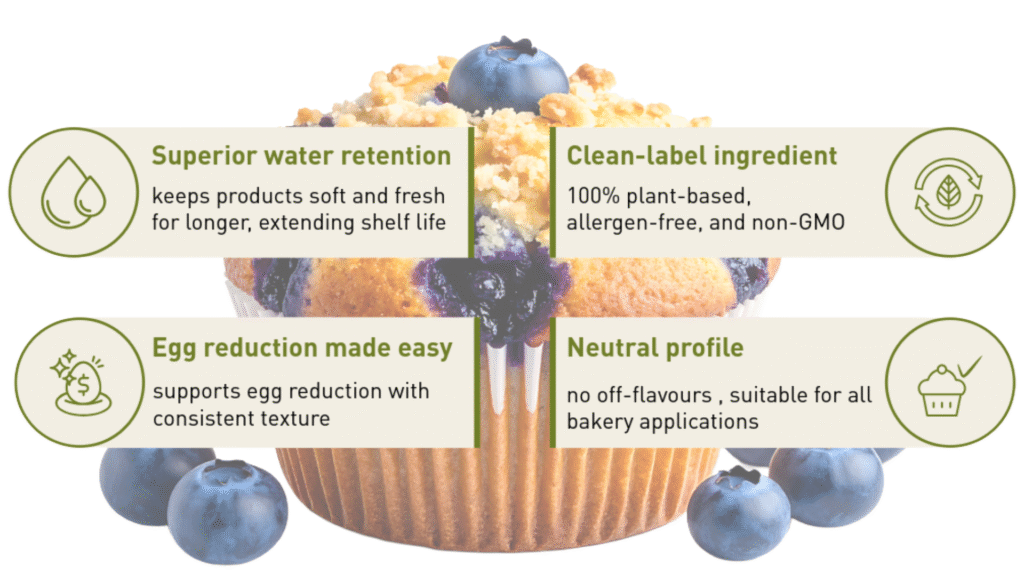
- Recommended dosage: 0.5–2.0% of total formulation (typical first trials: 0.8–1.5%).
- Best fits: sponge/pound cakes, muffins, Swiss rolls, and whipped toppings/fillings, where softness and fine, uniform aeration matter.
- Works in egg-reduced and egg-free recipes.
Cost Shield: A Simple Way to Estimate Savings
Replacing part—or even all—of the egg in bakery recipes, whether in whipped batters or fermented doughs, is an effective way to stabilize production costs in times of rising egg costs. By reducing a formula’s exposure to egg-price volatility, bakeries can plan more confidently and protect margins. With LASENOR® VP-100, you can preserve softness, structure, and shelf life while decoupling a meaningful share of the recipe from egg-driven fluctuations.
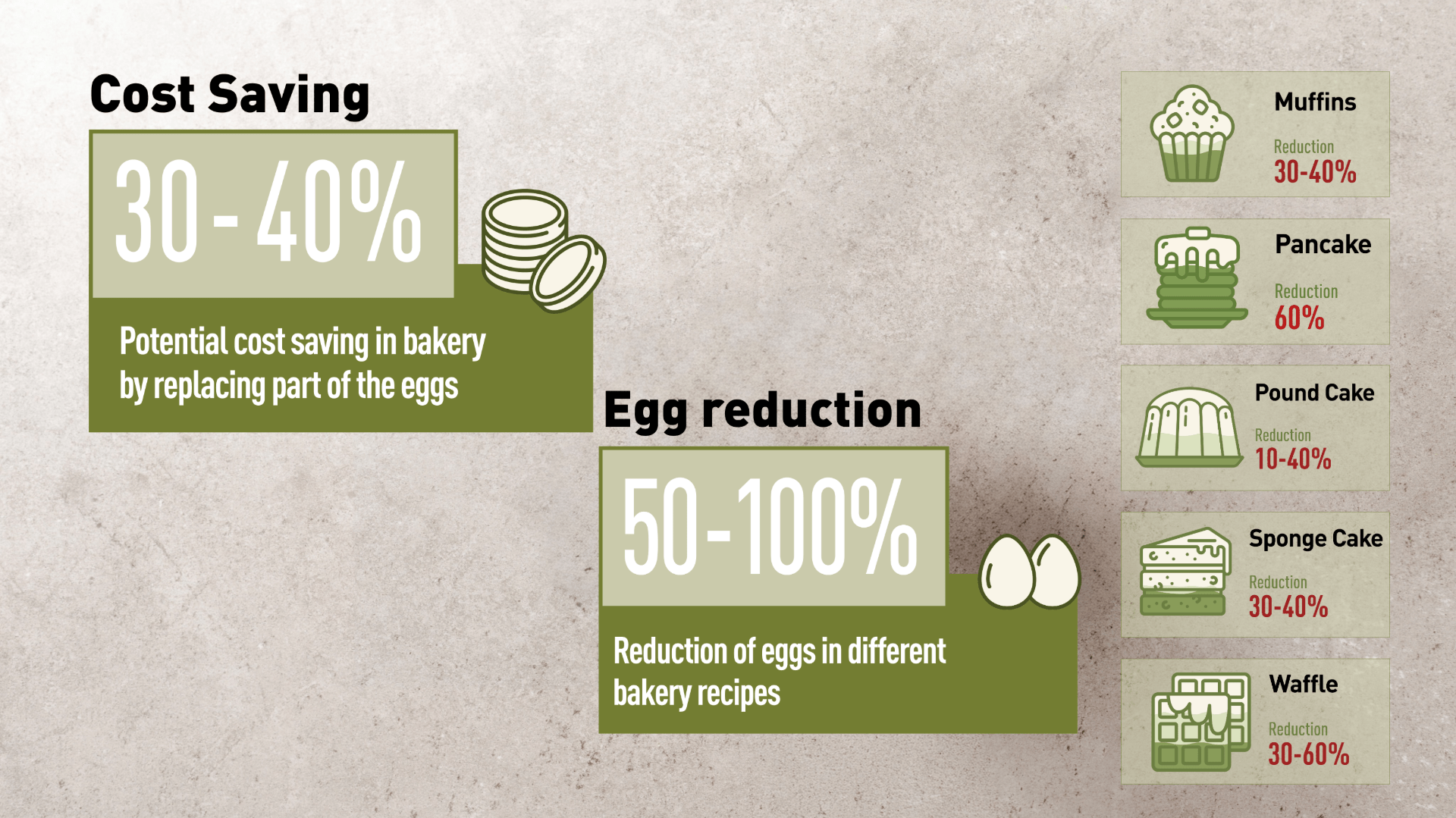
If you want to explore how LASENOR® VP-100 can help optimize your formulations or estimate potential savings, get in touch with Lasenor or speak with one of our application experts. We’re here to support your next innovation.