


Organic Ice Cream: Clean Indulgence and a Growing Global Trend
Organic ice cream transforms indulgence with clean ingredients and sustainable methods. Once a niche trend, it is now entering mainstream markets, driven by innovations in natural emulsifiers, gums, and plant proteins. As consumers look for products that blend pleasure, health, and environmental responsibility, organic ice cream emerges as the ideal balance of taste, transparency, and accountability.
THE RISE OF ORGANIC ICE CREAM
Ice cream has long been a symbol of comfort and pleasure, but today, indulgence means more than just flavor. Consumers now want products that not only perform well but also feel good, providing benefits for their bodies, the planet, and the people behind them.
This change has driven the growth of organic ice cream, where clean ingredients and sustainable production meet sensory delight. Once limited to artisanal shops and niche brands, organic ice cream is now entering mainstream markets and redefining what “premium” means in the frozen dessert category. It embodies a philosophy of transparency and responsibility, respecting nature while delivering the same creamy texture and rich flavor as traditional ice creams.
WHAT MAKES ICE CREAM “ORGANIC”?
Organic ice cream is characterized by its ingredients and how it’s made. To qualify as “organic,” at least 95% of the agricultural ingredients must come from certified organic sources, and only a few natural additives are permitted.
In the EU, this is regulated by Regulation (EU) 2018/848 and identified by the green Euro-leaf logo, while in the U.S., the USDA Organic seal ensures compliance with the National Organic Program.
Production facilities must also adhere to strict guidelines to prevent cross-contamination and utilize only approved cleaning agents and processing aids. In essence, organic ice cream represents clean ingredients, transparent sourcing, and responsible manufacturing, proof that indulgence and sustainability can coexist in every scoop.
FORMULATIONS: APPROVED INGREDIENTS AND NATURAL ALTERNATIVES

TECHNICAL CHALLENGES IN ORGANIC ICE CREAM
Creating organic ice cream involves more than just swapping ingredients. The main challenge is to keep creaminess, flavor, and shelf life intact while adhering to strict organic standards. Without synthetic emulsifiers or stabilizers, it’s harder to achieve a smooth, stable texture — natural gums like guar or locust bean can perform differently, influencing melt and crystal formation.
Other hurdles include the limited availability of certified inclusions (like cookies or syrups), color and flavor fading over time, and higher production costs due to ingredient scarcity and certification requirements.
Even so, innovation in organic lecithin, gum blends, and process optimization is narrowing the gap with conventional products, demonstrating that indulgence and clean labeling can coexist successfully.
SMART SOLUTIONS: ORGANIC FUNCTIONAL INGREDIENTS
Innovation in natural ingredient technology is helping overcome the challenges of organic ice cream formulation.
Modern organic lecithin, derived from soy or sunflower, acts as a natural emulsifier, dispersing fat and enhancing air incorporation to deliver a smooth, creamy texture that fully complies with organic standards.
New stabilizing systems based on organic gums and starches enhance viscosity, prevent ice crystal growth, and control melting in both dairy and plant-based recipes. Additionally, fibers and plant proteins from organic sources, such as citrus or pea, provide structure, water retention, and nutritional benefits.
Many suppliers now offer pre-balanced organic bases, simplifying production while ensuring consistency and clean-label integrity for both artisanal and industrial ice creams.
MARKET PENETRATION: GLOBAL TRENDS AND CLAIM COMPARISON
Although still a niche, organic ice cream has steadily grown over the past decade as consumers seek products that blend indulgence with healthier choices. North America and Europe remain the strongest markets, supported by mature organic food sectors and high consumer awareness.
Globally, approximately 6% of new ice cream launches now carry the “organic” claim, nearly double the number ten years ago. The trend evolves alongside other major claims:
- Plant-based/vegan, the fastest-growing since 2023, driven by demand for dairy-free and eco-conscious options.
- Sugar-free/reduced-sugar, appealing to health-minded consumers.
- Ethical labels like “Fair Trade” or “Non-GMO,” often paired with organic positioning.
While “vegan” and “low-sugar” products dominate headlines, organic ice cream continues to earn recognition for its authenticity, quality, and environmental integrity. Reflecting these preferences, flavor innovation remains crucial with classic favorites still leading global consumer choices (see Figure 1).
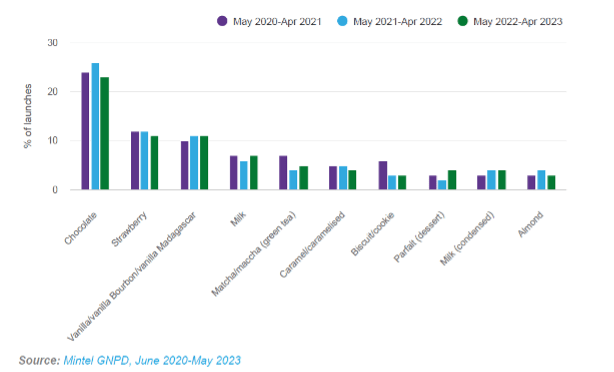
Globally, there is a strong demand for both premium traditional flavors and innovative new ones. For example, in Europe and North America, consumers continue to find comfort in familiar flavors, such as chocolate and vanilla. Still, they are also eager to explore new and adventurous options, especially when inspired by baked goods or desserts. In summary, while classic flavors such as vanilla, chocolate, and strawberries remain popular, there is a growing consumer interest in bakery-inspired, floral, cheese, fruit, and inventive flavor combinations, reflecting a desire for both comfort and novelty experiences.
Let’s create the perfect solution for your organic ice cream together!
Visit our pilot plant and take your innovation to the next level.
References and Sources
- Fernández Muerza, A. (2015). Helados ecológicos: qué son y cómo identificarlos. Consumer Eroski.
- Itaberco (2023). How to Make Organic Soft Serve: A Comprehensive Guide. Itaberco Knowledge Center.
- Mintel GNPD (2021–2024). Ice Cream Launches and Consumer Trends Database.
- Goff, H. D., & Hartel, R. W. (2013). Ice Cream (7th ed.). Springer, New York, Heidelberg, Dordrecht, London. ISBN 978-1-4614-6095-4.