


Organic Lecithin: what it is, how it’s made, and why demand is rising in food
Organic lecithin is a certified soy or sunflower emulsifier produced under EU/US organic standards with full traceability. It supports the shift toward sustainable food systems as promoted by FAO/WHO Codex. Used in bakery, chocolate, cookies, margarines, plant-based drinks, and instant powders, it enhances performance and final product quality. As organic demand grows, EU/US rules require organic lecithin when available. Lasenor meets this need by transferring know-how to crushers, monitoring residues, and providing trusted expertise across the lecithin value chain.
Introduction: Why the World Is Turning to Organic Food
Years of conventional farming have led to soil and water pollution. The heavy use of pesticides and synthetic inputs damages ecosystems and biodiversity, posing risks to human health as well. These consequences highlight the urgent need for a more sustainable agricultural model that can consistently provide enough food over the long term.

Organic farming provides such a model. As defined by the FAO/WHO Codex Alimentarius Commission (1999), it is a holistic production system that enhances the health of agro-ecosystems, biodiversity, biological cycles, and soil biological activity by relying, wherever possible, on agronomic, biological, and mechanical methods rather than synthetic materials.
The growing awareness of health risks and the importance of environmental protection has accelerated the shift toward organic production. Global demand for organic foods continues to rise, and these products are now readily available not only in specialty stores but also in mainstream supermarkets. While the production and sales of organic goods are primarily concentrated in highly developed markets, many less-developed countries are becoming significant producers and exporters of organic products.
Organic lecithin: definition, production process, and factors behind its higher cost
Lecithin is a natural mixture of phospholipids (e.g., phosphatidylcholine, phosphatidylethanolamine) widely used in food as an emulsifier, dispersant, and processing aid. In food, it typically comes from soy or sunflower, in fluid or de-oiled forms.
Organic lecithin is produced from certified-organic crops and audited processes (EU/US standards), ensuring full supply-chain traceability.
Organic oil extraction cannot use petrochemical solvents, such as hexane. Instead, oil, and therefore lecithin, is obtained via mechanical methods (e.g., expeller pressing at controlled temperature). Mechanical extraction generally yields less lecithin than conventional solvent processes, which affects availability and price.
Two structural constraints drive cost and scarcity:
- Smaller scale. Organic mills are usually much smaller than solvent-extraction plants, so the potential lecithin pool is limited—often discouraging CAPEX for gum production and drying.
- Lower mechanical yield. Purely mechanical processes reduce lecithin yield vs. conventional solvent processes, making production more challenging.

Average lecithin yield (per 1 metric ton of oil)
Applications Areas
In food, organic lecithin serves as a versatile emulsifier and processing aid across multiple categories.
- In bread and bakery improvers, it enhances dough handling and machinability, supporting consistent gas retention and stable structure through smooth enrobing and molding with predictable flow.
- In cookies and other baked goods, it promotes homogeneous mixing and fat dispersion and helps with clean release from pans and conveyors.
- In margarines or spreads (water-in-oil emulsions) and in sauces or other (oil-in-water emulsions), lecithin stabilizes the interface between phases, helping to prevent separation during processing and storage.
- In infant foods, lecithin is used as a permitted emulsifier or processing aid where regulations allow, provided the ingredient meets the applicable microbiological and contaminant specifications.
- In chocolate and coatings, it gives rheological tuning, controlling plastic viscosity and yield value, to enable.
Why is the demand for food rising?
- More organic products on the shelf – as organic food becomes mainstream at retail, manufacturers need organic-status inputs to maintain the certification of their final products, including lecithin.
- Label compliance – EU/US organic frameworks increasingly expect organic lecithin, where commercially available, thereby driving demand specifically in food categories.
Competitive Advantages of Lasenor’s Organic Lecithin
Not all crushing companies have the technology or the interest to obtain crude organic lecithin suitable for food-grade lecithin specialists. Lasenor provides the technical know-how to crushers to complete the process and get proper crude organic lecithin.
To secure the integrity and quality of certified-organic lecithin, Lasenor operates a residue analysis program that confirms reliability and compliance with organic standards.
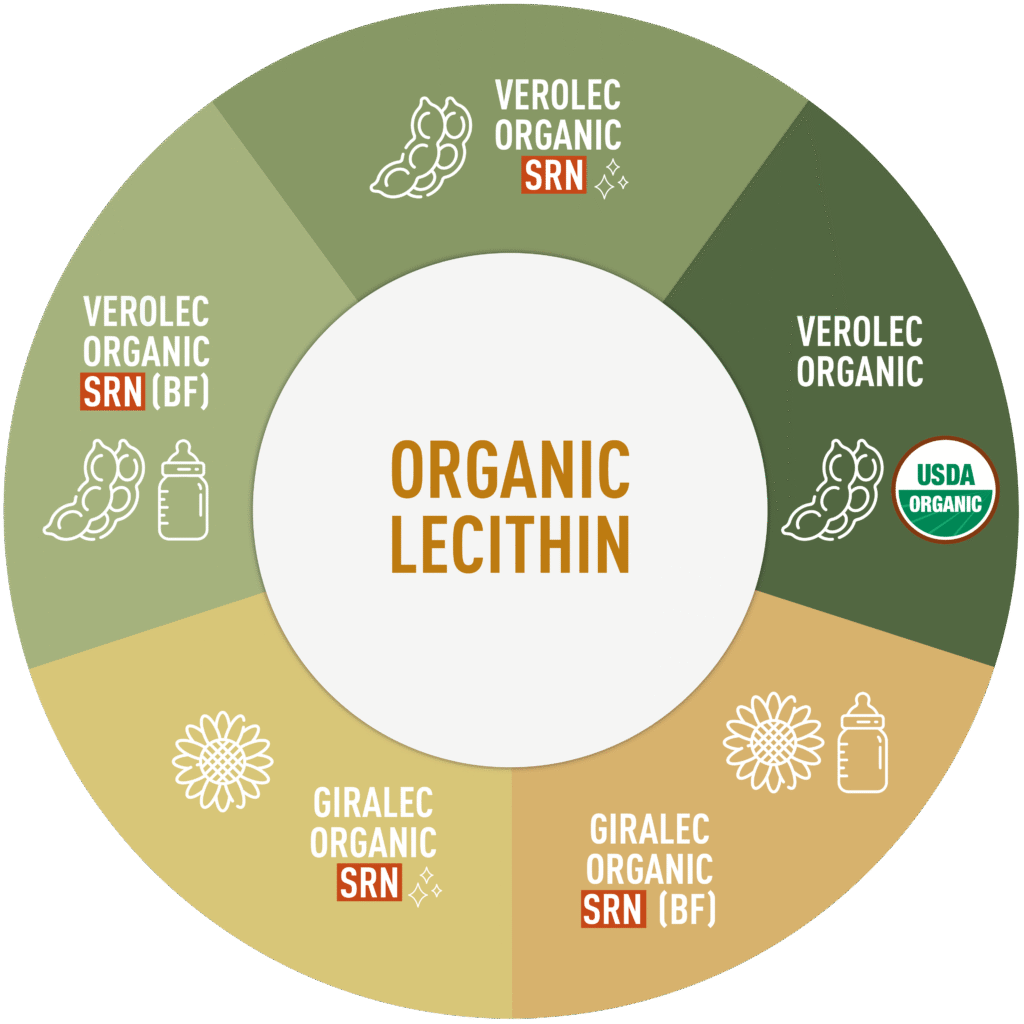
Organic development starts here — contact us to know our solutions!
References and Sources
- FAO/WHO Codex Alimentarius Commission. (1999). Guidelines for the Production, Processing, Labelling and Marketing of Organically Produced Foods (CAC/GL 32-1999).
- Mintel. (2025). Organic Attitudes & Behaviors in US Food & Drink and market research.
- Lasenor. Organic Lecithin — Technical Paper.
- Norn, Viggo. Emulsifiers in food technology.2nd edition (2015). ISBN-978-0-470-67063-7.